


What happens when law students are asked to build a legal concept out of LEGO® bricks?
This pedagogical exercise, featured in a 2026 article of The Law Teacher turns an apparently playful classroom activity into an encounter with the constraints and social assumptions underlying legal meaning-making.
The exercise focuses on public order, a vague legal concept lacking a single, universally accepted or authoritative definition. Rather than trying to explore its doctrinal meaning, the exercise invites the students to experience how such concepts are constructed. First, students individually write down their immediate associations with public order and rank them by importance. These associations and their rankings then become the boundaries within which they are expected to think. They then work in small groups to create a physical representation of the concept using LEGO® bricks. Finally, they present their constructions and reflect on the process.
The experience of unease is central to this process. Law students are accustomed to a discipline that values precision, expected forms of (legal) reasoning, and authoritative answers. They may find it unsettling to be asked to represent an abstract legal concept using a material more readily associated with childhood play than legal scholarship, one that requires translating the meaning of public order into a set of metaphors. The unexpected task challenges not only students’ assumptions about law but also their expectations about what counts as legitimate academic work.
The unease becomes more tangible through the exercise’s material constraints as different groups of students receive different sets of bricks. Some get plentiful, colourful pieces, while others get fewer bricks or pieces that are difficult to connect. These unequal resources then produce markedly different representations. As can be seen in the photos taken in one staging of this exercise, one group constructed a colourful park featuring a family and a hidden surveillance camera, while another built a police car and a garbage truck. A group with very limited resources arranged disconnected pieces on paper.
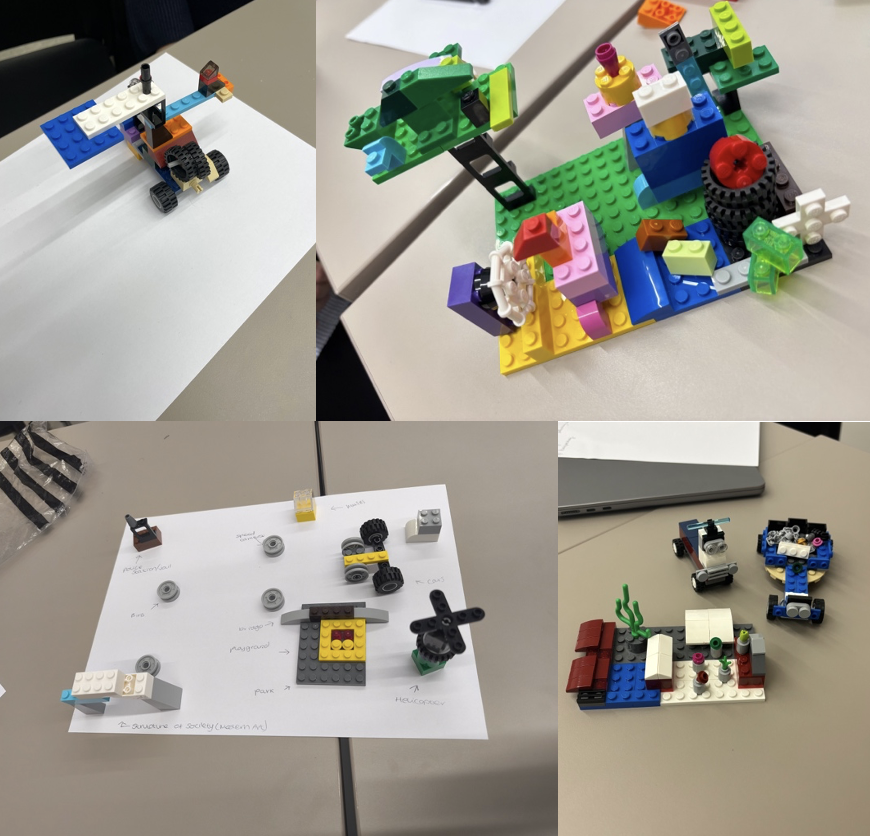
These differences then lead students to reflect on how the resources available to them shaped what they could imagine and construct. From student feedback: One participant connected the contrast between the colourful park and the police-centred representation to differences in social privilege: people living in an idyllic environment may experience surveillance differently from those whose surroundings are associated with policing. Another important moment came when students realised that they had not considered borrowing bricks from other groups. They had implicitly accepted the resources allocated to them as fixed boundaries, despite nobody explicitly prohibiting them from seeking alternatives.
The exercise thus turns unease into an opportunity for critical reflection. Constraints help reveal how people adapt to circumstances, reproduce implicit rules and sometimes mistake socially established assumptions for natural or inevitable arrangements. The bricks themselves also resist unlimited interpretation: their shapes, connecting points and available combinations restrict what can be built. Similarly, the meanings students bring to public order are shaped by prior knowledge, cultural expectations and established social representations.
This exercise ultimately demonstrates the pedagogical value of discomfort that prompts curiosity rather than discouragement. By making an abstract concept physically tangible, it exposes the gap between the apparent objectivity of law and the social processes through which legal meaning is produced. Students do not simply learn that legal concepts are socially constructed. They experience the constraints, compromises and unspoken assumptions involved in constructing them. The resulting unease becomes a starting point for questioning how legal meanings acquire authority and how they might have been constructed differently.
Read the full report on this exercise, its theoretical reasoning as well as student feedback in Smejkalová, T. (2026). Construction of vague legal concepts: the LEGO® experience. The Law Teacher, 60(2), 409–432.