
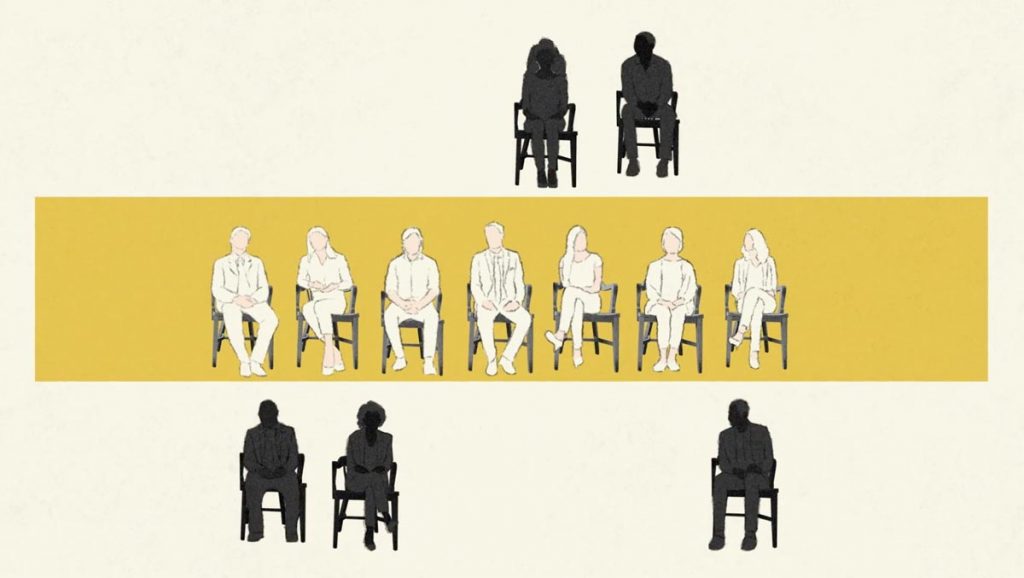
The right to a jury of peers is enshrined in U.S. law, yet the selection process has historically favored white jurors, systematically excluding black individuals through various legal and procedural barriers.
In the context of the recent trial of Ahmaud Arbery's murderers (2021), the jury selection process (voir dire) highlighted significant racial disparities, with a jury composed of eleven white jurors and one black juror, despite a local population that is 27% black (or identifies as such). This situation echoes historical precedents, such as the 1992 Rodney King trial, where racial bias in jury composition was evident.
The voir dire process, intended to ensure impartiality, often perpetuates discrimination. Historically, juries were composed of the social elite, excluding slaves and free blacks. Although legal advancements, such as the Civil Rights Act of 1875 and the Supreme Court's ruling in Strauder v. West Virginia (1880), aimed to rectify this, discriminatory practices persisted. The Batson v. Kentucky (1986) ruling sought to limit peremptory challenges based on race, yet its implementation has been inconsistent, allowing for continued exclusion of black jurors.
Their systemic exclusion is further exacerbated by socioeconomic factors, as many potential jurors from marginalized communities are not represented in jury pools due to issues like voter registration and economic hardship. Additionally, the use of jury consultants has led to strategic exclusions based on perceived biases, reinforcing racial disparities.
The composition of juries significantly impacts verdicts, with studies indicating that all-white juries are more likely to convict black defendants. The lack of diversity in juries not only undermines the legitimacy of the judicial process but also perpetuates a cycle of racial injustice. Calls for reform, including the elimination of peremptory challenges and the implementation of more inclusive jury selection processes, are essential to address these systemic issues.
Keywords: Racial discrimination, jury selection, voir dire, systemic bias, Batson v. Kentucky, socioeconomic factors, jury composition, racial justice, legal reform, representation.
Further readings:
Golash, D. "Race, Fairness and Jury Selection." Behavioral Sciences & the Law, vol. 10, no. 2, 1992, pp. 155-177.
Jackson-Gleich, G. "Rigging the Jury: How Each State Reduces Jury Diversity by Excluding People with Criminal Records." Prison Policy Initiative, 18 Feb. 2021.
Lee, C. "A New Approach to Voir Dire on Racial Bias." U.C. Irvine Law Review, 2015, p. 843.
Nunn, K.B. "Rights Held Hostage: Race, Ideology and the Peremptory Challenge." Harvard Civil Rights-Civil Liberties Law Review, no. 28, 1993, pp. 63-118.
Sloan, A. "What to Do About Batson?: Using a Court Rule to Address Implicit Bias in Jury Selection." California Law Review, vol. 108, 2020, pp. 233-266.
Sommers, S.R. "On Racial Diversity and Group Decision Making: Identifying Multiple Effects of Racial Composition on Jury Deliberations." Journal of Personality and Social Psychology, vol. 90, no. 4, 2006, pp. 597-612.